Celsius to Fahrenheit: How to Convert Temperature Fast
Learn how to convert Celsius to Fahrenheit using the exact formula, a quick mental trick, real-life examples, and a full temperature reference table.
TOOLS
SimpleUnitConvert
4/4/20264 min read
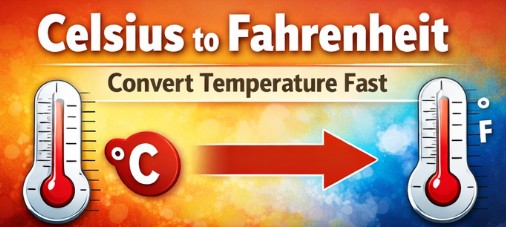
Temperature is one of those things we deal with every day — checking the weather, cooking a meal, or understanding a fever reading. But when you're looking at a US weather forecast showing 95°F or following an American recipe that calls for an oven at 375°F, those numbers can feel completely meaningless if you're used to Celsius.
This guide will show you the exact formula, a quick mental shortcut, step-by-step examples, and a full reference table so you always know what temperature you're dealing with.
What is Celsius?
Celsius (°C) is the temperature scale used in most countries around the world including Australia, the UK, Canada, and Europe. It is part of the metric system and was designed around water — water freezes at 0°C and boils at 100°C at sea level.
Common Celsius reference points:
0°C — water freezes
20°C — comfortable room temperature
37°C — normal human body temperature
100°C — water boils
What is Fahrenheit?
Fahrenheit (°F) is the temperature scale used primarily in the United States and a few other countries. It was developed before Celsius and uses different reference points. Water freezes at 32°F and boils at 212°F.
Common Fahrenheit reference points:
32°F — water freezes
72°F — comfortable room temperature
98.6°F — normal human body temperature
212°F — water boils
The Exact Formula
To convert Celsius to Fahrenheit use this formula:
°F = (°C × 9/5) + 32
Or written another way:
°F = (°C × 1.8) + 32
Both formulas give exactly the same result — use whichever feels easier to remember.
Step-by-Step Examples
Example 1: Convert 0°C to Fahrenheit (0 × 1.8) + 32 = 0 + 32 = 32°F
Example 2: Convert 20°C to Fahrenheit (20 × 1.8) + 32 = 36 + 32 = 68°F
Example 3: Convert 25°C to Fahrenheit (25 × 1.8) + 32 = 45 + 32 = 77°F
Example 4: Convert 37°C to Fahrenheit (37 × 1.8) + 32 = 66.6 + 32 = 98.6°F
Example 5: Convert 100°C to Fahrenheit (100 × 1.8) + 32 = 180 + 32 = 212°F
Example 6: Convert -10°C to Fahrenheit (-10 × 1.8) + 32 = -18 + 32 = 14°F
The Quick Mental Trick
The exact formula requires a calculator but there's a handy approximation for quick mental estimates:
Double the Celsius temperature and add 30
For example:
20°C → (20 × 2) + 30 = 70°F (actual answer is 68°F — close enough)
25°C → (25 × 2) + 30 = 80°F (actual answer is 77°F)
30°C → (30 × 2) + 30 = 90°F (actual answer is 86°F)
This trick isn't perfectly accurate but it's good enough for a quick weather check or casual estimation.
Real-Life Uses for Celsius to Fahrenheit Conversion
1. Checking weather when travelling to the US If you're visiting the United States and the forecast says 95°F, that sounds extreme — and it is. That's 35°C, a very hot summer day. Knowing how to convert quickly helps you pack the right clothes and plan your activities.
2. Cooking with American recipes Most Australian and UK ovens display temperature in Celsius, but American recipes list oven temperatures in Fahrenheit. A recipe calling for 350°F is asking for about 177°C, which is a moderate oven. Getting this wrong can ruin a meal.
3. Understanding fever temperatures Normal body temperature is 37°C or 98.6°F. A fever in adults is generally considered to be above 38°C or 100.4°F. If you're reading a medical guide in Fahrenheit, knowing the conversion can help you assess how serious a temperature is.
4. Science and school Physics and chemistry often require temperature conversions between scales. Understanding the formula and why the scales differ is a fundamental part of science education.
5. Reading international weather apps Some weather apps default to Fahrenheit depending on your device settings or the region you're looking up. Being able to convert on the fly means you're never caught off guard.
6. Food safety Safe food storage and cooking temperatures are sometimes listed in Fahrenheit in American guides. For example, chicken should be cooked to an internal temperature of 165°F, which is 74°C.
Celsius to Fahrenheit Reference Table
Frequently Asked Questions
What is the formula to convert Celsius to Fahrenheit? Multiply the Celsius temperature by 1.8 (or 9/5) then add 32. The formula is °F = (°C × 1.8) + 32.
What is 100°C in Fahrenheit? 100°C equals 212°F. This is the boiling point of water at sea level.
What is 37°C in Fahrenheit? 37°C equals 98.6°F. This is normal human body temperature.
Is there a temperature where Celsius and Fahrenheit are the same? Yes — at -40 degrees both scales give the same reading. -40°C equals exactly -40°F.
What is a normal room temperature in Fahrenheit? A comfortable room temperature is around 20-22°C which equals 68-72°F.
What is 180°C in Fahrenheit for baking? 180°C equals 356°F, which is commonly rounded to 350°F. This is a moderate oven temperature used for cakes, biscuits, and roasting vegetables.
How do I convert Fahrenheit back to Celsius? Subtract 32 from the Fahrenheit value then divide by 1.8. The formula is °C = (°F - 32) ÷ 1.8.
Common Mistakes to Avoid
Forgetting to add 32 The most common error is multiplying by 1.8 but forgetting the final step of adding 32. Always remember the formula has two parts.
Using the wrong direction To go from Celsius to Fahrenheit you multiply then add. To go from Fahrenheit to Celsius you subtract then divide. Mixing these up gives completely wrong answers.
Using the mental shortcut for precision work The "double and add 30" trick is fine for casual estimates but don't use it for cooking, medical readings, or scientific work. Always use the full formula or a converter tool for accuracy.
Quick Tip
Don't want to do the maths? Use the free Celsius to Fahrenheit converter on Simple Unit Convert for instant results. No sign-up required.
About
Simple Unit Convert
Convert units instantly — weight, length, volume, and temperature made simple.
Links
Popular conversions
No login required • Free to use • Works worldwide
© 2026. Simple Unit Convert | All rights reserved.